
Written by Katalis · 3 min
The receptionist nobody replaced.
Of everything people ask about AI, none carries more feeling than whether it takes people's jobs. Let me answer it the honest way: with a thought experiment, clearly labelled as one, and with the uncomfortable part left in.
Written by Katalis · Updated 24 September 2026
The rules of this thought experiment
This is a made-up scenario about a typical Tuesday for an imaginary receptionist at a clinic. There isn't a real client to describe. Some firms create these stories as if they're true, but we don't. Instead, here's a thought experiment that's clearly labelled as such. Meet a receptionist. She doesn't have a name because she's not a real person.
Tuesday, without the assistant
The phone rings before the doors open. By mid-morning, she has answered the same three questions about twenty times: do you have anything this week, how much is a check-up, and where do I park. She's also greeting arrivals, chasing two no-shows, and rebooking a cancellation by calling down a waiting list one number at a time. In the afternoon, she makes reminder calls for Thursday and deals with a backlog of voicemails from lunch when nobody could answer. The people in front of her — the anxious one, the confused one, the one who needs ten seconds of reassurance — get whatever attention she has left. That's the job as thousands of front desks actually run it: a human being used as a router.
Tuesday, with the assistant
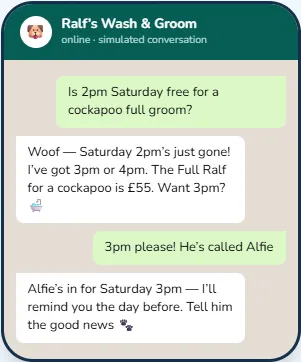
Imagine the same clinic, but now an AI assistant handles routine tasks. Twenty repeated questions get answered instantly, any time. It knows the diary, prices, and parking details. Reminders go out on their own. Cancellations fill from the waiting list automatically. The voicemail backlog mostly disappears because callers get answers straight away. Her Tuesday still fills up, but now with tasks that need a human touch: the person at the desk needing personal help, complex bookings with three appointments, judgement calls, and reassurance. The role remains. The routine tasks don't.
Capacity, not redundancy — and the exception, stated plainly
For most small businesses, it's about capacity. The same team can handle more work, better, without extra stress. This can be the difference between just coping and growing without hiring new staff. Most small firms are stretched, not overstaffed, so that's where the value lies.
But let's be honest. If your goal is to run leaner, AI can help with that too. Some consultancies might not tell you this, but we will. Our focus is on taking routine tasks off humans, not taking humans off the payroll. We'll be clear with you, before anything is built, about what your plan really means.
If you're weighing this up for your own team
The useful question isn't 'which people?' — it's 'which tasks?'. List what a role does in a week and sort it into two groups: tasks that are repetitive and rule-based, and those that need judgement and warmth. AI only handles the first group. Bring the list to me if you like — I'll sort it with you, honestly, including the parts I'd leave alone.
Free tool · runs right here
Free Business Score
See how your business looks online — findability, website health, reviews and more — with the few fixes worth doing first.
No sign-up · instant · it’s me that runs it — the same tool, live on this site.
Wondering what AI would actually change for a specific role in your business? Describe the role and I'll tell you honestly which parts would lift away and which are permanently human.
Ask me about your team →Prefer to just ask? Chat with Katalis · More from the blog